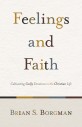
Books often meet a need. My friend was devastated when her mate left her after forty-three years married. She went searching for help. This book delivered. There is a need for this type of book, one that offers spiritual truth in addition to practical hands-on ways to apply then incorporate it into real life. Traditionally, in evangelicalism, the realm of feelings and emotions was largely treated as a simple formula of confess the sin, get right with God, and all will be well. Those who were struggling often felt alone in their suffering. This is a somewhat academic book with an emphasis on feelings and emotions as they relate to spiritual living. I found it to be somewhat dry in the first few chapters which relate to a biblical foundation for truth but increasing in interest as Borgman delves into the nuts and bolts of dealing with our human emotions like anger, unforgiveness, bitterness, fear, anxiety, worry, and depression; then offering solutions found in confession, renewing of the mind, relationships, reading, meditating, prayer, and imagination. Faith and Feelings opens the door for greater exploration of the relationship of feelings with faith.
Many evangelicals have become suspicious of the emotions and generally discount them. This is tragic. Others have so exalted experience and the emotions that they have minimized truth, doctrine, and theology. This too is tragic. The glorious reality is that truth and emotions, faith and feelings, theology and experience are not enemies, but the best of friends.

THERE’S NO BETTER TIME THAN NOW TO GET YOUR WRITING ON. Do what writers do and begin expressing what is in your heart. The first time I met with a writing instructor I was told that writing is a craft that one must learn. Good books don’t just happen, they come through a birthing. You may be like me. I have a drawer full of writings that I wrote over the years that have never come to print and were never meant to. Some were caused by overflow within me. Why do writers write and authors author? Here are a few of the reasons.
- We write because we have something to say. We know what we know. We like what we like. We love what we love. We don’t like what we don’t like. It bubbles to the top–in and out–much like a mountain spring, it flows out from our inner well.
- We write because we have a love of words. We like how they sound. We like their musicality. We like the game of finding just the right word. It’s like a puzzle that one works at until you find the exact piece that fits. Our craft is one of words and their inner connections and vital signs.
- We write because of an inner compelling. We give voice to our emotions. Our heart bids expression. We write, in love. We write, emotional, even angry. We write, unhappy. We write, ecstatic. We write, enthusiastic. We write, lonely. We write with urgency. We write, we write, we write. There are times we write as a therapeutic exercise, only for ourselves.
- We give voice to our words for we are writers of messages. We write to say worthwhile considerations, something that needs to be shared. We write so that people can learn and grow. We write through our voice of experience. We write to teach as a way to communicate what we wish to say. We wish to influence as a way to cause others to think and consider. We seek to state our cause succinctly with passion or grace or force. We are messengers. This is why we write, even when we are our only audience.
- We write to encourage or cause emotion. We write to validate, to praise, to appreciate, to sympathize, to empathize, to lift up, to set down, to remember, to correct, and to guide. We know words have power. We are the guardians of our words and we take our guardianship of them with great seriousness.
- We write to establish a presence that speaks. We write to create a business model, to execute to the next level. We write with personal or professional agenda, to make sketch of the realistic non-fiction venue or to share our talent through the casual informal note of the letter writer.
I choose to write for all of the six reasons I have stated. If I didn’t have something to say, I am sure I wouldn’t spend the hours I do at the computer trying to say it. I’d do something else with my day.
I encourage you to write if you are so inclined. Don’t put it off. There is no better time than now. Do it, and keep at it until you get it right. I think I can, I think I can . . . said the little engine that could.
Bless you.
Let me know how it’s going. I’d love to hear.
Norma