This blog is from my book The Meeting Place . The quotation is a summary of my conclusions from an on-going spiritual quest. I am still on this same quest and believe it is a journey that teaches much more than I could have imagined on the outset.
Note: The quote’s text is broken up for ease of reading. I selected this section because it contains a key concept and also shows my emotional angst. It is my favorite passage of the book because I believe it highlights a powerful message. I hope you enjoy its reminder. †††
BOOK QUOTE: THE MEETING PLACE: Moments with God at Lookout Point pages 180-185.
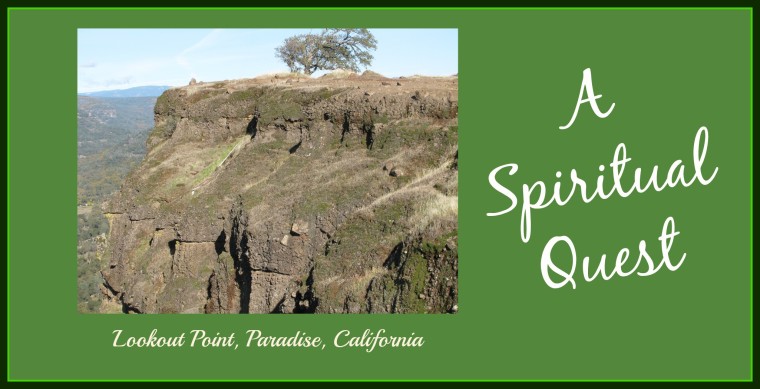
My thoughts were such that I considered how in life there are some things that are hard to accept, especially when there is a break in fellowship with people of the faith or ones with whom we have shared a close bond. Instead of peace, there is barrenness, a form of death that separates and comes between—much as this deep canyon separates to form walls on each side of the mountain.
It has been almost three years of letting go of the pain from the fracture I was thinking about while we were talking, three years of trying not to believe what I thought God was telling me in those earlier days, soon after the damage was done, during the times when I sought him for answers in fervent prayer and brokenness.
Its aftermath has changed me from the person I used to be. It is an odd thing really, quite different from any of my past spiritual experiences. Because of something I said, a door shut that has yet to be reopened; a valued friendship imploded like some terrible mistake. Immediately and for months to come, I seemed to sense God’s displeasure with me.
It felt as if I had walked out on God’s will, plan, and his good favor and that I had willfully chosen my own way. Because of this, for months I lived in a state of aloneness, even a sense of separation from God’s touch—which is something I cannot explain well even to myself, but trust me, it is a place of void and darkness. Yet it also became my teacher.
Surprisingly, at the time another door began to open, and light flooded in during this painful period in my life. I found myself on a spiritual quest, seeking a new direction, searching for truth and understanding beyond my strongly held Protestant beliefs and scriptural interpretation of bible doctrines.
I began to read some of the saints and mystics from the Middle Ages and more recent writers of Christian thought from the early and mid-1900s including several women from the 1800s and 1900s: Protestant, Anglican, and Catholic in breadth.
A hunger grew in me for more of God in personal unity of “relationship.” I began to read life stories and expressions written by people who knew God, not just about God. I could identify with many of these various writers, their words ringing true in my thinking. Some of what they recorded I could have written; the tone was the same with a warmth of expression one finds in the writings of people who love God.
Their words addressed what had been closed and unmined prior to my exposure to their vibrancy. One can find the heart of the person by what they say or the affective filter of their collective works. I no longer was looking so much at their theological positions but more at their statements regarding God and his influence, his outworking in their lives.
As a result of this, my quest of which I am still on, my outlook changed immensely even though my interpretation of scripture remained much the same. I began to see with new eyes. This was a powerful gift God gave me during this period of dryness in my spiritual life, my “dark night of the soul.” In addition to my Dark Night of the Soul, walk with God, this has particularly and significantly contributed to the inward changes in my person. I will never be the same, and that’s an understatement.
It has fundamentally altered me in how I think and how I approach the Christian faith and also the family of believers. I have become less rigid and more kind, less certain but more open, less opinionated and more loving. It is a spiritual journey outside the box of religious convention and limited parameters, yet not one of compromise or the forsaking of biblical truth. My belief in the fundamentals of the faith and personal salvation through Jesus Christ remains firmly in place. More of God and less of me. Praise the Lord.
However, the problem still remained. It has never been easy for me to to accept change or friction in personal interactions, or to “let go” when their time has ended. While I traveled this darkened spiritual path, most every waking moment I experienced a constant troubling in my thoughts and spirit, like something unsettled and not quite right, out of focus and gray. As much as I tried, I could not remove its thorn from my heart nor find inner peace. Because of its persistence and presence, it was difficult to deal with the many responsibilities on my plate. The sorrow and the aloneness were strong, taking with them my energy and free spirit.
My months of visits at The Meeting Place helped resolve some of its pain, but nothing could completely remove its sorrow. Slowly over time, I regained my footing with God and returned to my “sweet place” of receiving grace and love from his abundant mercy. One morning a year or so later, while I was getting ready for church, I sensed God’s voice telling me what the real trouble had been, my part in the problem.
It seemed as if God was explaining to me that when I had voiced my concerns by stating my doubts, they originated in my uncertainty and need for security, and in the doing of it, I had failed to trust him when I could not see the way.
I had failed the test, after years of God telling me to “trust him,” I had failed to trust. The thought made sense to me. I had failed to trust God, and instead, I had trusted in my own common sense, problem solving, and somewhat negative thinking. But that being as it may be, I could never dismiss my inner belief that God would restore this lost friendship and open up communication between us in some way. In my many quiet times on this topic, it seemed as if God entered my thoughts, affirming and speaking to this end, that someday all will be well and as it should be. God is the God of the impossible.
Did not Abraham wait many years for a son of promise? Did not Hannah ask for a son when she was barren? Did not Joseph bear many sorrows before God used him to accomplish a miracle of divine breadth and love? Nothing is beyond God’s ability to perform and accomplish—when it is in accordance with his perfect will and purpose.
I sense it and feel it; there is still a part to be played out. How, when, or what, I do not know, but this I do know; my wishes, my desires, and my future are in God’s hands. I no longer wait in expectation or anticipation for that which has not come to pass. Yet I have not been able to dismiss the possibility either. God knows what he is doing, and I do not. If he chooses to redeem the past, it is his to do—as he wills. God knows best, and I know he also acts on our prayers according to his will and good favor.
I have learned much though in my search for understanding and truth. People of many denominations and religious affiliations worship the same God—in spirit and in truth. Only God knows an individual’s true heart and in whom or what they base their faith. It is belief in Christ where one finds truth; it is the one uniting truth that crosses religious boundaries or constraints and brings the universal church of God together in harmony and freedom.
One can keep their biblical stance and interpretation, religious formalities, beliefs, and doctrinal positions—without compromise and still have the capacity to extend love, grace, and acceptance to sisters and brothers across the aisle, who have this same love of God in their hearts, who believe in Christ as Lord and Savior. But there’s the rub; we don’t always know who does and who doesn’t have genuine faith. Be loving anyway. How freeing this is to know and believe that God calls us to be faithful to the vision, the central truth of Christ’s Life, which he has given to each one of us as his children.
CONSOLATION [My conversation with God at Lookout Point]
Father God, I think of this friend and I think of what is. Somehow it still seems to not be right. While I was walking last night, I thought of how it has seemed wrong, the sense of being out of your will—the center of your will that is—ever since that night (when I broke fellowship with my friend). It seems like Satan had a part to play in it. But maybe you did, too.
I did.
What do you want me to pray?
Go forth, and don’t look back. You will find what you seek. You will find me. I will give you life in abundance.
Yes. (I smile.) That’s all I want. Lord, open my eyes to see you. I want to see Jesus. Worthy is the lamb that was slain.
My daughter, I love you. You are one of my precious chosen. Walk in my way. Walk worthy of me. Do not look to your right or to your left even though everything crashes around you. (I picture the scene in the movie Lord of the Rings, with the volcano erupting and Frodo and Sam walking out on the ledge with fire on both sides of them). I don’t have a ring (like Frodo), I have a cross, the cross of Jesus Christ. “Onward Christian Soldiers . . . with the cross of Jesus, going on before.”
Sometimes we do what we have to do, but it is not nice what we have to do.
In your writings are words of truth. My truth will come through your words. Speak them.
Father, the words I speak are from my heart.
Know that I am in control. I move people to do my will. Make peace with the past. Fast today. Seek me all day.
What about all my work? I have so much to do to prepare for the week.
It can wait. Seek me until you find me in fullness.
Yes, Lord.