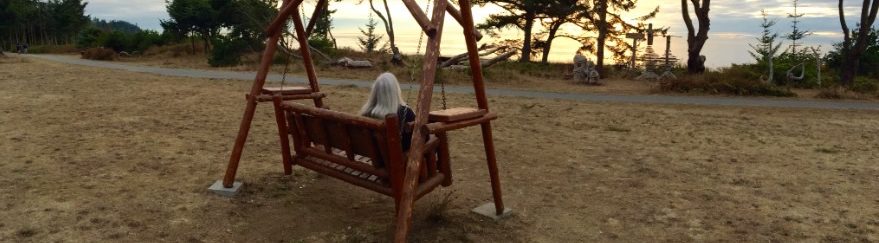
“Your name is Norma?” she inquired in the form of a statement, “My name is Norma too.” She was the first person to greet me at the women’s conference where I would be speaking the next day. I appreciated her friendliness and welcoming smile. Her white-blond hair was long. She wore a full floor-length print skirt in keeping with the folksiness of the mountain community. Her eyes twinkled and her smile came naturally. I liked her immediately.
Our paths did not cross again until a few minutes before I was to speak the next afternoon. She entered the almost empty room where I had been praying and refreshing my thoughts in preparation for my upcoming talk. Bits of Norma’s story spilled out: Her birth as a preemie; the presence of physical pain most of her sixty-some years; her occupation as a nurse. There had been much hardship but God had been her resource. She said she was looking forward to my talk. She felt God wanted her to be in my class instead of the other choices, even though it wasn’t the one she would have chosen.
My talk was on the need for healing in the emotions through the touch of God. I stood before the eclectic mix of women. That I knew none of them within a personal context, really didn’t matter. We were sisters. Where there are sisters, there is bound to be pain. Pain is a uniter. Pain would bring us close and hope would bind us even closer. It was my desire to help these ladies before me to begin to heal. I wanted to provide guidance for this area of spiritual life is often a lonely and difficult journey. Other people don’t always understand.
In my talk I opened up about my life—the good girl who suffered in the hidden places behind the mask—who kept on keeping on as life delivered a roller coaster of emotional hits. I shared about my then dead feelings and lack of joy, which was my ever present reality in those days. Their presence was a silent shadow I could not shake. I explained how I kept close to God as the hurtful experiences piled up one after the other. And I shared with the ladies, how I loved and forgave and continued on as I believed any faithful Christian should do. Perseverance during the hard times was not the issue. The issue was, I didn’t know what to do with the pain. My story line continued on. . . the women were intently listening to my words. We were coming to the critical point that was made out of desperation, but would embrace my healing. . .
The breaking point came many years later. I was on empty and used up. I lost my husband; there was another woman. My job was ending, been down that road before and it’s a tough one. My five children were angry and hurting; I didn’t know how to help them nor what to do. My self sufficient reserves were depleted; I had nothing left to give. I told God I couldn’t do it anymore; He would have to do it. I loved the Lord. I trusted Him. But something had gone desperately wrong, and I didn’t know how to fix it. I reasoned: If I have to go through this, I want to learn in the process.
I made a decision that day which would change my life. It was more in the form of a declaration. First, I asked God to heal me. Next, I wrote a list of ten items I wanted God to change in me. I anchored my request with a vow to share everything I learned with anyone He put in my path, with other co-sufferers lost in the pain of a broken spirit and wounded life.
We were at the most important part of my talk, how to access healing. I shared how healing of my inward self came in increments, amazing moments when God reached in and revealed the buried pain to heal it and then set it free. It was a process: I surrendered, sought God, absorbed His word, and hungered for God. Now at the intersection where God could meet a need, I continued on.
During God’s help in healing me of a hurtful memory—the first time I was told I wasn’t loved—God helped me understand that when Christ suffered on the cross it was through His wounds and stripes I was being healed; how Christ had felt my pain and had been with me through it all. I cried so hard my heart hurt. Then amazing peace entered my soul.
A few days later I noticed that something was different in me. The inner sorrow and sadness were gone. Twinges of joy began to blossom within me. This was new. I felt like a butterfly coming out of its cocoon, drying its wings, getting ready for its virgin flight. To my utter amazement within a year every single item on my list had been touched by God, and I had gained intimacy of relationship with Him.
I answered a few questions and then retreated to the back of the room to an empty pew. My new friend Norma slipped in beside me. Her words were trembling, bursting forth. “God knew why I was supposed to be here today. You have no idea.” Then more of her backstory came out: the pain and suffering, the abuse, neglect and hurtful words. She explained her long-standing desire to live in the presence of joy.
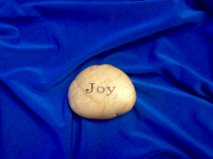 Norma opened her hand. A smooth brown stone with the word ‘Joy’ etched in it rested in her palm. “For years I have carried this stone with me as a reminder to have joy” she explained. It was her worry stone, there to keep her focused. “I want to give it to you.” Norma handed me her stone. Why is she giving it to me? I wondered. Norma’s face beamed. Her eyes sparkled. Her smile was pure radiance. “You see, I don’t need it anymore.” She was like a bird let out of a cage, set free on the inside. God had ministered to Norma in a special way.
Norma asked if she could purchase one of my books. I gave her one. With joy I signed it, “To Norma, ‘God Alone.’ Norma”
Have you ever meaningfully connected with a stranger? What was that like?