
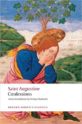
Confessions (Oxford University Press, 2009 edition (400 AD))

This book surprised me. I enjoyed reading it cover to cover although I expected it to be dry and rather dull. The confessions are a personal narrative by Augustine of Hippo about his spiritual journey. It is written like he is talking to God about his life and we are privileged to get to listen in. I have to say, I thought Augustine’s take on life in the times in which he lived not all that different from the belief and practices of the millennials of our times. That, in itself, was fascinating to me. Born in Africa, and then later, at age 17, educated in Carthage, Augustine had a diverse background. Augustine lived loose and fast with life. He fathers a son with his long-term mistress. He prides himself on his intellectual ability; he is a brilliant fellow.  In his Confessions it is as if Augustine is taking us through his thought processes and concerns as he wends his way to faith. It is similar to reading a journal but one with great insight and clarity about life and his part in it. We see glimpses into past history where Christianity is finding its way in and out of culture and popularity.

Augustine argues some of the same arguments we still toss around. We see him participate in public oratory as participates in debate in the public square. The popular philosophical thought of the day is attractive to him and the appeal of the Manichean religious belief hooks him (to his mother’s despair). He takes the Catholic church to task as he looks at religious philosophy and says, why and how? Then he meets Ambrose, a teacher of rhetoric like Augustine, but a man of faith. In the man Ambrose he finds a different sort of religious person. His confessions lead us to his time of conversion and beyond. Much is philosophical in nature. All changes at the point of conversion. Monica, his mother, is finally at peace. In many respects she has lived her life for her son. Monica devoted herself to seeking God for her son’s repentance and salvation. She figures into Augustine’s story as a major player, a person who both helped and irritated her son. He could not escape her concern and prayers.

Augustine follows the Christian faith from then on and becomes a leader in the church. He is remembered as one of the central figures in church history as one of the influential Church Fathers in Western Christianity. The original Confessions was written by Augustine of Hippo around 400 AD. He became a presbyter first, then bishop around 395. There are numerous translations of Saint Augustine’s Confessions. Some stray from the original intent more than others. I read Confessions: Saint Augustine, translated by Albert C. Outler from the Barnes & Noble Classics. This review is from that copy. I do not have a link to Amazon’s books for that specific translation.

A Place Called Sacred (4)

Dear Father God, help me to listen. Help me to see. Help me to know You. Help me to embrace Your love. Father, I want to sense Your presence. Fill my whole self with an awareness of You.  You are beautiful. You are worthy. You are everything.

SACRED SPACE (1)

You can make your own space sacred.

FB July 2011 004Choose a specific place where you will conduct your alone time with God. Be intentional in your choice. Outside influences must be minimal. The setting selected will be well suited if it is free of clutter, confusion, noise, and other people. A chair, bench, vehicle, somewhere to sit including the floor are possible locations. Any place will do that is isolated from the normal busyness of life and has a sense of calm, peace, and soft beauty. Change it up once in awhile.

Minimize distractions. Turn off electronic devices such as phones, IPads, computers, music devices, and anything that makes noise or causes interruption in the flow of thought. A room in the home can make a good place for a sacred space when you manage its function as “sacred” by preparing it as a quiet corner for the purpose of meditation, contemplation, contemplative or interactive prayer, or the practice of silence. For a lengthy time of meditation, you may need to hire a sitter for the kids or critters in-order to manage this. It is imperative that your sacred space have little or no interference.

The possibilities are endless: You may select a spot out in nature, in a quiet room, on a park bench away from activity, in a church sanctuary, in the chapel at a monastery or on its grounds, at a picnic table near the lake, or sitting on a patio chair or porch swing. Some find a stark room the best. Some sit on the floor and sit tall. I think of Scripture and its admonition to enter your own prayer closet.

This place is not to be used for one-way talking or for nice platitudes. It is for quiet time with God that is open, honest and deep. We listen as we speak or think. We ponder in the silence. We raise our thoughts Godward as we rest in His majestic fullness.

This is a practiced spiritual discipline that one must cultivate.

You may choose to sit on a log surrounded by trees in the forest or sit on a rock amid the desert rocks, or you may stand with your toes in the sand on the ocean surf. The deal is, you must seek a place with surroundings that aid you in your receptivity and sensitivity to what God has for you, to become still, to take a pause from the daily activity…aware of His presence and holiness, and to actively listen while in the deep, deep silence. God speaks. “He leads me beside the still waters.” “My sheep hear my voice.”

  1. Select a quiet place where you can be by yourself.
  2. Remove distractions and noise.
  3. Repeat the first paragraph of this writing.
  4. Open your thoughts to God. Rest in His Presence.
  5. Make mental or physical note of your thoughts and feelings
  6. Ask, seek, and knock; pray, meditate, and contemplate; or remain silent in the deepness.
  7. Practice silence with God once soul-rest has been activated.
  8. Read Scripture, hymns, psalms, or words of praise (unless the objective is silence)
  9. Make sure it aligns with God’s ways, then act on what He gives you.
  10. Thank Father God for what you have received.

Note: This draws us closer to the heart of God and becomes possible once we have a restored relationship with Him (called salvation). Jesus Christ, through His life, death, and resurrection, made it possible for us to believe in Him and to partake of His everlasting love. Sincere faith in God and trust in Him and His offer of life will cause a conversion of the soul, which begins at the time of belief but is ongoing as we continue to transform in our spiritual self to become more like our Savior, Jesus Christ. He calls to us, and we respond. This comes first before the deeper understandings are accessed.

During this time of quietness you may find yourself weeping. That is a response to God and His Holy Spirit. You will find that the silence is not silent. You become spiritually full when you listen for the presence of the Father, Son, and Holy Spirit in a non-human, peace-filled, other-worldly, God-directed way.